Perspective
Think Small. Build Big.

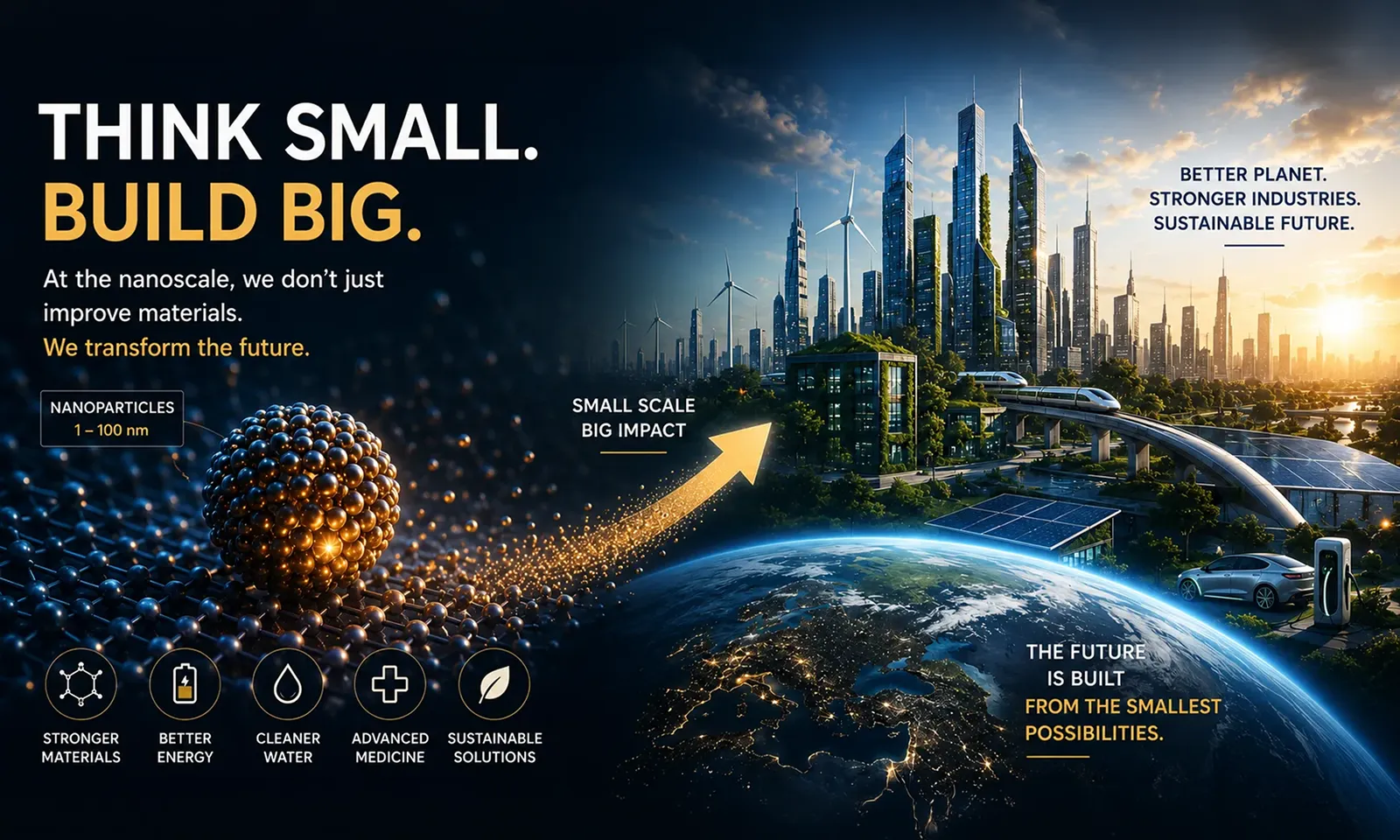
If you lived your life thinking size didn’t matter, you are going to have a shock of your life, but not in the way you imagined. The other way around. We built taller skyscrapers, larger factories, faster aircraft, bigger ships, and more powerful machines. Every industrial revolution seemed to demand more steel, more concrete, more energy, and more scale. But the next revolution is taking a different path. Instead of building bigger, we are beginning to build smaller. At the nanoscale.
A nanometer is one billionth of a meter. If a marble represented one meter, a nanometer would be about the size of a single atom in comparison. A human hair is nearly 100,000 nanometers wide. It is a world invisible to the human eye, yet it is becoming one of the most important frontiers in science and engineering. Because at this scale, matter behaves differently.
When Physics Changes
The remarkable thing about nanoparticles is that they are made from the same elements we have always known. Gold is still gold, and carbon is still carbon. Yet when these materials are engineered at the nanoscale, their properties can change dramatically, primarily due to the change in surface area these materials now have. Gold nanoparticles can appear red or purple instead of metallic yellow. Carbon atoms arranged into graphene create a material stronger than steel, lighter than aluminium, and an excellent conductor of electricity. Titanium dioxide nanoparticles enable self-cleaning glass. Nanostructured coatings can repel water, eliminate bacteria, reduce friction, or reflect heat. Nothing has changed about the atoms themselves, only their arrangement, and the surface area that comes from being nanoparticles.
This is one of nature’s greatest lessons: extraordinary performance is often achieved not by changing what something is made of, but by changing how it is designed.
Nature Has Been Using Nanotechnology for Millions of Years
Long before scientists coined the term “nanotechnology,” nature had already mastered it.
The lotus leaf remains clean because its surface is covered with microscopic and nanoscale structures that cause water to roll away, carrying dirt with it. Butterfly wings produce brilliant colors without pigments; their nanoscale structures manipulate light itself. Spider silk combines incredible flexibility with remarkable strength through the precise arrangement of proteins.
Even human bones owe much of their resilience to the nanoscale organization of collagen and mineral crystals. Nature rarely wastes material. Instead, it engineers structure. That is precisely the direction modern technology is beginning to follow.
A Philosophy Beyond Science
Nanotechnology teaches a lesson that extends beyond laboratories. The greatest transformations often begin with things that seem insignificant. A single idea can create an industry. A single innovation can redefine a market. A single decision can change the future of a company. A single person’s will can change the world.
Likewise, atoms arranged differently can transform an entire material. The principle is universal. Small improvements, intelligently designed, compound into extraordinary outcomes. Success is rarely the result of one giant leap. It is usually the accumulation of countless small breakthroughs.
The Next Industrial Revolution
The next industrial revolution will not be defined solely by artificial intelligence, robotics, renewable energy, or biotechnology. It will be enabled by the materials that make all of them possible. Behind them will be materials engineered at scales too small for the human eye to see. The future will belong to those who understand that true innovation is not about making things bigger.
The future is going to be built by thinking smaller.