Climate
The Snowball Effect of Global Warming
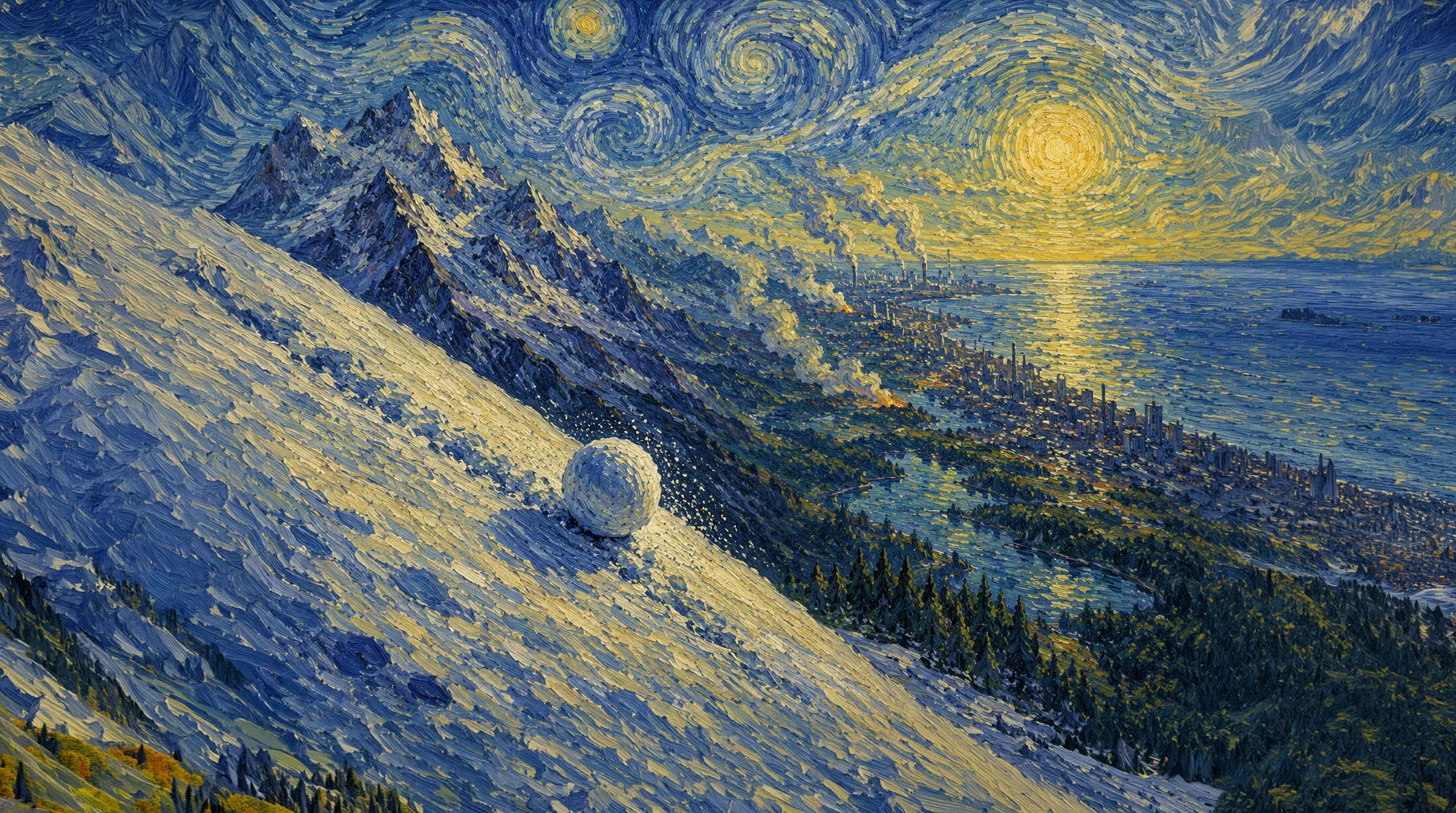
A Snowball in a Warming World
A snowball and global warming seem like a paradox. However, the best way to explain what the impact of global warming has reached today, there is nothing better than a snowball.
A series of many events over the years has created a snowball effect that is becoming increasingly difficult to stop.
To understand why, we need to look at Earth’s four fundamental elements: Air, Earth, Water and Fire.
Air: Where the effect is most direct & where it all begins
The atmosphere is Earth’s thermostat. Every additional ton of carbon dioxide and other greenhouse gases released trap more heat that would otherwise have escaped into space.
Warmer air holds more moisture, fuels more extreme weather, and creates the conditions for every other climate process to accelerate.
The snowball starts to roll.
Earth: The Planet adds to it
As temperatures rise, glaciers retreat, permafrost thaws, and forests come under increasing stress.
Melting ice exposes darker land and oceans that absorb more sunlight, while thawing permafrost and degrading forests release even more greenhouse gases into the atmosphere.
The snowball grows.
Water: Nature’s Cooling System Under Pressure
The oceans absorb much of the excess heat and a significant share of the carbon dioxide produced by human activity, slowing the rate of warming.
But warmer oceans expand, sea levels rise, marine ecosystems weaken, and the oceans gradually become less effective at regulating Earth’s climate.
The snowball accelerates.
Fire: The Accelerator without any brakes
Hotter temperatures and prolonged droughts are creating larger and more frequent wildfires.
These fires release enormous amounts of carbon dioxide while destroying forests that once removed it from the atmosphere, further reinforcing the cycle.
The snowball becomes an avalanche.
The Hidden Tipping Point
Perhaps the most alarming consequence of this snowball effect is unfolding beneath the ocean’s surface invisible to all our eyes.
As the oceans absorb more carbon dioxide, seawater becomes more acidic. This reduces the availability of carbonate ions—the building blocks that corals, shellfish and many marine organisms need to form their shells and skeletons. As carbonate becomes scarcer, shells weaken, coral reefs struggle to grow, and entire marine ecosystems come under threat.
At the same time, warming and changing ocean conditions are disrupting phytoplankton—the microscopic organisms that form the foundation of the marine food web. Despite their size, phytoplankton absorb vast amounts of carbon dioxide and produce a significant portion of the oxygen we breathe.
As these natural systems become less effective, the oceans absorb less carbon, leaving more carbon dioxide in the atmosphere and allowing the snowball effect to gather even greater momentum.
Conclusion
Around the world, governments, scientists, businesses and communities are investing in renewable energy, carbon capture, reforestation and countless other climate initiatives. These efforts matter, but the scale and speed of our response are still struggling to match the scale and speed of the challenge.
To confront a problem that has snowballed to this scale, we need solutions as well that can snowball—solutions that are self-reinforcing, scalable and capable of creating positive feedback loops that grow faster than the problem itself.

At ROX Capital Group, we believe the next generation of climate solutions must do exactly that. Our focus is on identifying, investing in and developing technologies and nature-based solutions that have the potential to multiply their impact over time.
The challenge before us is no longer simply to reduce emissions. It is to create a chain reaction of solutions that grows faster than the chain reaction of the problem itself.
We are creating one of the world’s first net zero Skyscrapers in Dubai. We want this to be a beacon of light and change that will snowball & scale into bringing a transformation all over the world!