Perspective
The Future Is Not a Compromise
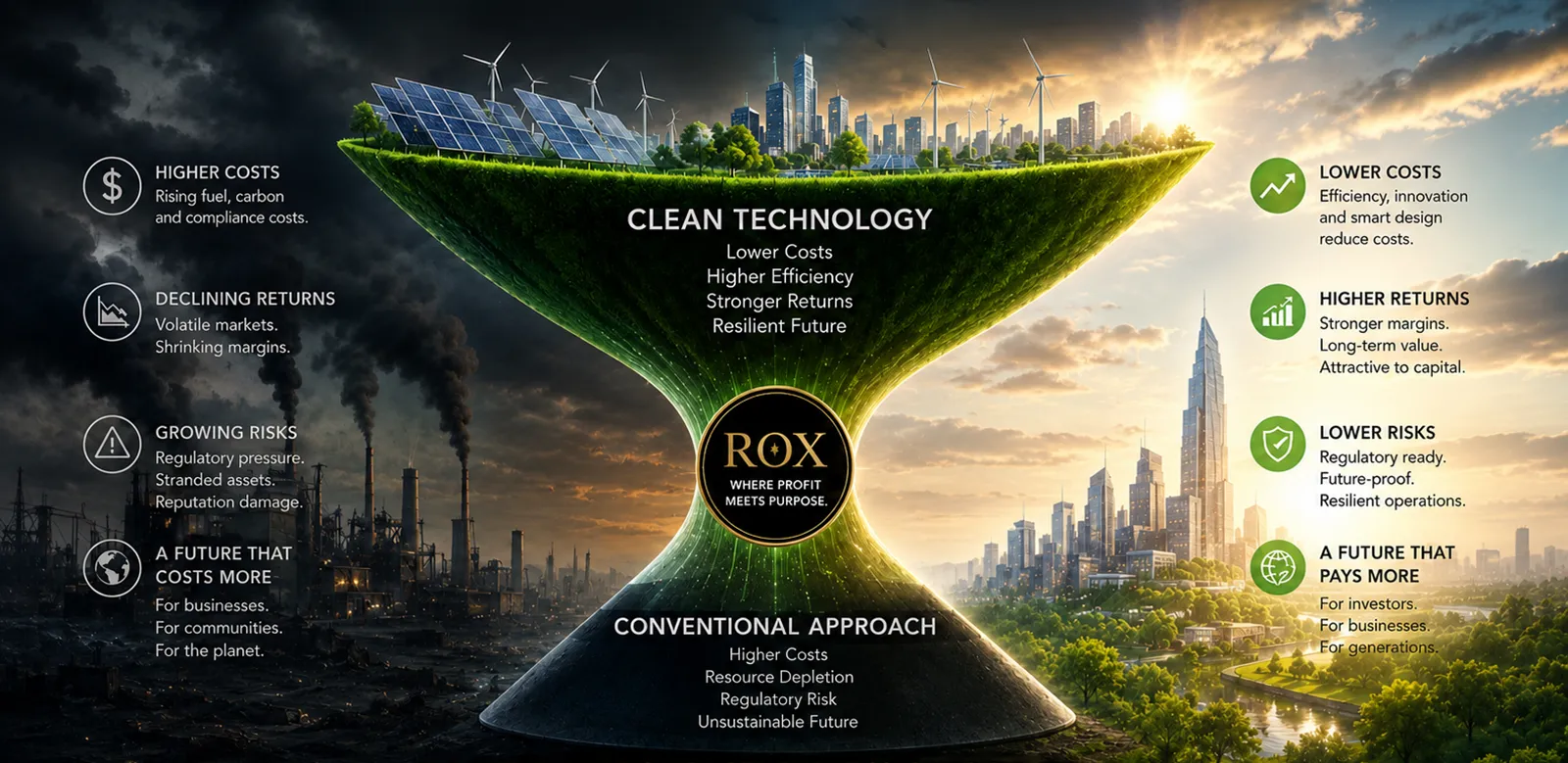
For decades, the investment world has treated climate technology as a compromise. If you wanted strong financial returns, you invested in traditional industries. If you wanted to help the planet, you accepted lower returns, longer payback periods, subsidies, and uncertain economics. The grants available today for climate technology and renewable energy run into the thousands. This has become the new charitable institution of the corporates.
At times the things we do to help others do more damage than if we had done nothing. A famous proverb captures the same message:
Give a man a fish and he will eat for a day; teach a man to fish and you will feed him for a lifetime.
The Cost of Treating Sustainability as Charity
The consequence of taking this approach to sustainability is multi-fold:
- Set a low bar. Lower expectations on any initiative with the word sustainability in it.
- Image. Over time, sustainability gets linked to poor performance.
- Talent. The best talent works in industries that are competitive and pay higher salaries.
- Free pass. The real problem still exists. Corporates use the label of sustainability to bypass poor industrial practices.
- Not given the importance. It never becomes the centre of what we do. That is where it belongs.
There are many more consequences which have caused it to remain relegated to second place. I would even dare to say it has played a role in the high-inflation, high-debt scenario we are in today.
Some investors pursued climate solutions because they believed it was the right thing to do. Others avoided them because they believed profitability would always come second. This thinking has become deeply embedded in global finance.
We believe it is completely wrong.
Goodwill Will Not Solve This
The world’s climate challenge is too large to be solved through goodwill alone. Governments cannot subsidize the transition forever. Consumers cannot be expected to pay a permanent green premium, and investors cannot be asked to sacrifice returns indefinitely.
If solving climate change depends on people willingly earning less money, then we have already lost. The solution is not to convince the world to accept lower returns. The solution is to redesign climate technology so that it produces higher returns than conventional alternatives. That is the intersection where the future will be built.
Built to Outperform
At ROX Capital Group, we believe the next generation of climate technologies must be commercially superior before they become environmentally transformative. Every clean technology should answer one simple question:
Does adopting this technology create more economic value than continuing with the existing solution?
If the answer is no, adoption will always depend on regulation, subsidies, or public pressure. If the answer is yes, markets will do what markets have always done: they will scale it faster than any government ever could.
Economics, Not Morality, Drives Adoption
History repeatedly shows that the technologies which reshape civilizations are not adopted because they are morally superior. They are adopted because they are economically superior. The steam engine replaced manual labour because it was more productive. The automobile replaced horse-drawn transport because it was faster and cheaper. The internet transformed communication because it created enormous economic value.
Artificial intelligence is spreading globally because it improves productivity. This very article would have taken me three times as long to write without it. Climate technology should follow the same path.
Our objective is not to build technologies that merely reduce emissions. Our objective is to build businesses where reducing emissions is the very reason profits increase. Imagine solar systems that generate more lifetime value than fossil energy. Construction materials that capture carbon while lasting longer and costing less to maintain.
When Sustainability Becomes the Moat
When environmental performance becomes a competitive advantage rather than a compliance requirement, adoption no longer requires persuasion. It becomes inevitable. This changes everything. Instead of asking companies to spend money to become sustainable, sustainability becomes the reason they outperform their competitors.
Instead of governments carrying the transition, private capital accelerates it. Instead of relying on marketing campaigns, adoption is driven by economics. That is how every major technological revolution has unfolded.
The climate transition should be no different.
Our Philosophy
This is the philosophy guiding our investments at ROX Capital Group. We are not searching for projects that sit somewhere between profitability and sustainability. We are searching for opportunities where sustainability itself creates profitability. Where environmental impact becomes an economic moat. Where clean technology is not a cost, but the engine of superior financial performance.
When that happens, something remarkable occurs. Capital flows naturally and businesses adopt rapidly. We don’t need to rely on the morality of the world to bring transformation. The profit-seeking behaviour that drives corporates and shareholders will itself accelerate it.
And the planet benefits. Not because people were convinced to make sacrifices, but because the sustainable choice became the most profitable choice.