Perspective
Should the Price of Nature Be a Footnote or a Decision Maker?
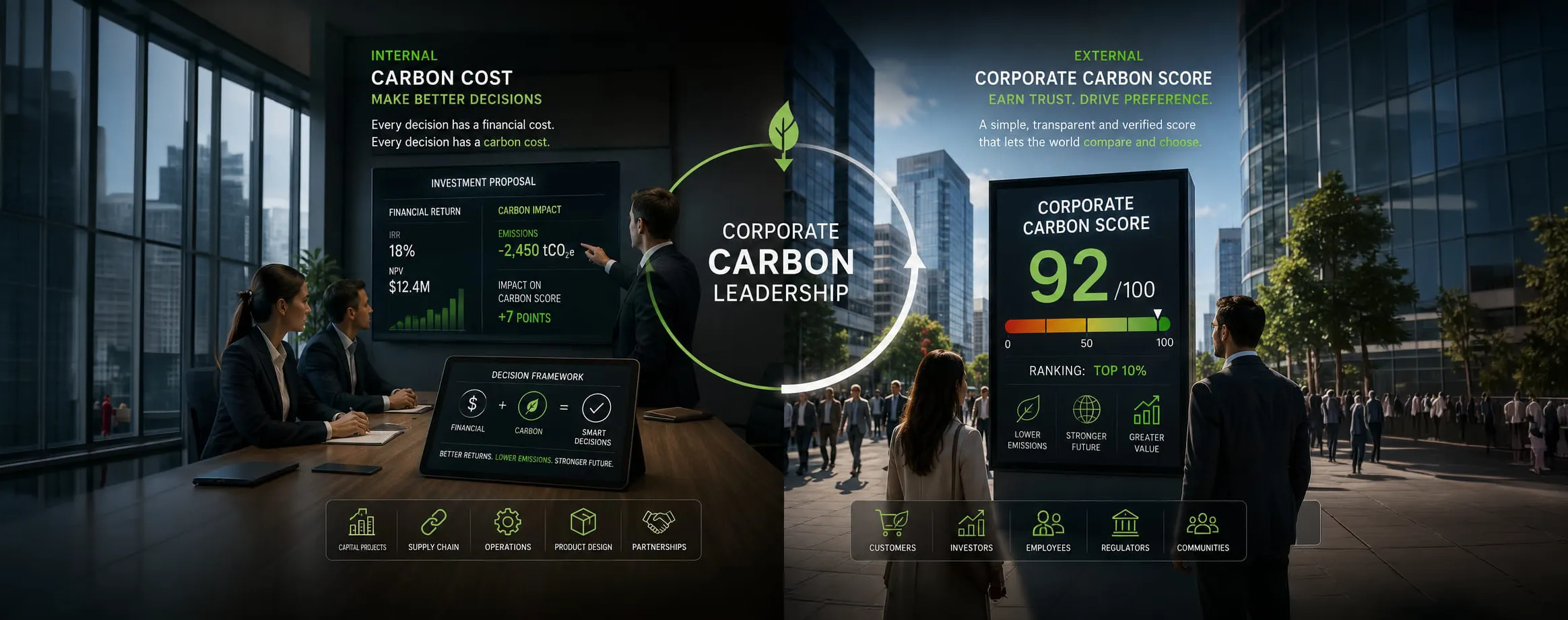
From Annual Report to Competitive Advantage
Businesses measure everything that matters. They track revenue, profit, margins, cash flow, customer satisfaction through the Net Promoter Score (NPS), and financial health through countless KPIs. These are debated and every decimal point adjusted for shareholders, because they directly impact salaries, bonuses, performance reviews, and dividends.
Yet one of the most important indicators of long-term value, the environmental impact of a business, remains buried in an annual sustainability report that few people ever read. If we want to make a material change to the world and reverse the damage we have caused, we need to take the problem seriously and make it part of every critical decision a business takes. The only way to do that is to make it financial, since corporate actions are driven by bottom-line and top-line growth.
1. Internal: Every Decision Should Include a Carbon Cost
Every significant business decision should be evaluated on two dimensions: financial cost and carbon cost. Whether approving a capital project, selecting suppliers, designing products, expanding operations or building new facilities, companies should quantify not only the financial return but also the impact on their carbon footprint. Carbon should become another boardroom metric, reviewed alongside ROI, NPV and payback period.
When every investment carries both a financial price and a carbon price, sustainability moves from being a reporting exercise to becoming part of everyday decision-making.
2. External: Every Company Should Have a Corporate Carbon Score
Every corporation should have a Corporate Carbon Score (CCS): a simple, transparent and independently verified rating that measures how effectively it reduces and manages greenhouse gas emissions.
The score should become as familiar as a credit rating or an NPS. Imagine choosing between two supermarkets with similar prices. One has a Carbon Score of 92, the other 54. Which would environmentally conscious customers choose? A visible Carbon Score would let customers, investors, employees and regulators compare companies within and across industries, rewarding those that genuinely lead on decarbonization. Governments could even give tax breaks or incentives to corporates in the top 5% of their industry’s Carbon Score.
Companies would compete not only on profitability, but also on environmental performance. Reducing emissions would no longer be viewed as compliance. It would become a source of competitive advantage, stronger reputation and long-term value creation.
The companies of the future will be remembered not only for how much profit they generated, but for how responsibly they generated it.