Perspective
Is Energy the Next Threshold for Global Dominance?
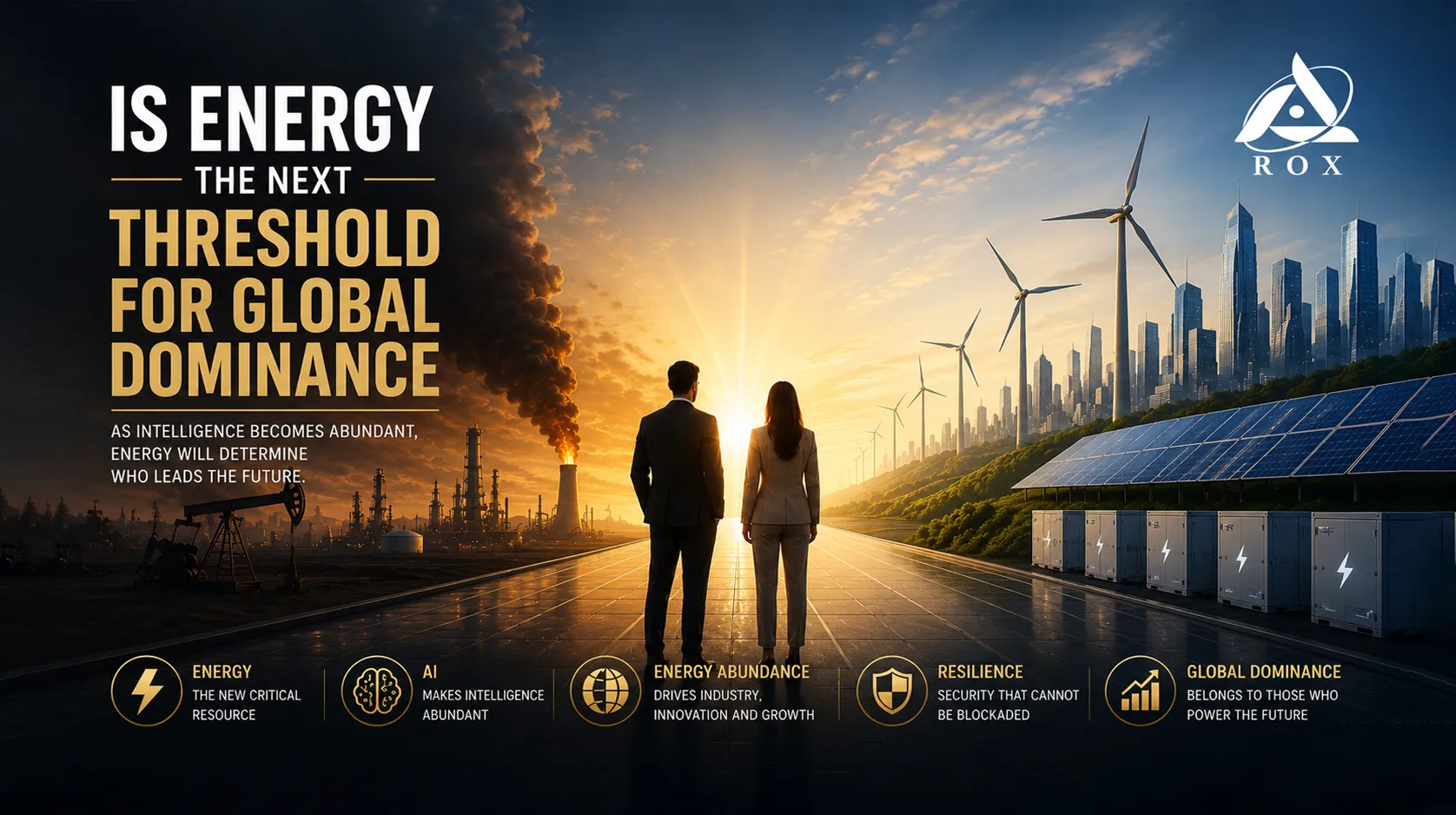
For most of modern history, global power has been determined by whoever controlled the most critical resource of the era. In the 20th century, that resource was largely oil. Over the last 30 years, the equation has shifted. Human capital, education, technology and intelligence became the great sources of competitive advantage. Nations that attracted the world's best scientists, engineers, entrepreneurs and financial talent built extraordinary economic power.
But we are now entering another transition.
Artificial intelligence (AI) is beginning to make intelligence itself increasingly abundant.
So what becomes the next constraint?
It is the critical resource that runs AI – The most important for AI is Energy.
From Oil to Intelligence to Energy
Oil powered the industrial revolution. Human intelligence powered the information revolution. Artificial intelligence may power the next productivity revolution. But AI requires enormous amounts of computing power, and computing power requires electricity. Data centres, robotics, semiconductor manufacturing, automated factories, desalination and increasingly electrified economies will require vast quantities of reliable energy.
The equation of the future could be:
Cheap energy → cheap computing → greater productivity → greater economic power.
Energy Is Becoming a Strategic Resource
Recent wars and geopolitical conflicts have demonstrated how vulnerable concentrated energy infrastructure can be. Oil fields, refineries, pipelines, storage facilities and shipping routes can be attacked, disrupted or blockaded. Energy is therefore no longer simply a commodity.
Energy Is Becoming a Strategic Resource
Recent wars and geopolitical conflicts have demonstrated how vulnerable concentrated energy infrastructure can be. Oil fields, refineries, pipelines, storage facilities and shipping routes can be attacked, disrupted or blockaded. Energy is therefore no longer simply a commodity.
It is critical national infrastructure.
This creates an important advantage for renewable energy. Oil and gas are concentrated resources that depend on large infrastructure networks. Renewable energy is fundamentally different. Sunlight is abundant. Wind is distributed. Renewable generation can be spread across thousands of locations.
A solar farm can be damaged, but the sun that provides the energy cannot be destroyed. A country with abundant renewable resources, storage, distributed generation and resilient grids could therefore create an energy system that is not only cheap, but significantly harder to control or disrupt from outside.
The New Superpower Equation
Imagine a nation with enormous quantities of reliable, inexpensive electricity. It could attract AI data centres and advanced manufacturing. It could produce hydrogen and ammonia. It could desalinate water or convert moisture from air to water. It could process minerals and manufacture energy intensive products domestically. Cheap energy would attract capital. Capital would build more infrastructure. More infrastructure would create even greater industrial capacity.
The great powers of the future may therefore be defined by:
Energy + AI + Capital + Infrastructure + Industrial Capacity.
The question of the next 30 years may be: Who controls the cheapest, most abundant and most resilient energy?
Because if artificial intelligence makes intelligence abundant, energy could be the new threshold for the next global power.
And the nation that solves that problem first may possess the foundation of the next superpower.